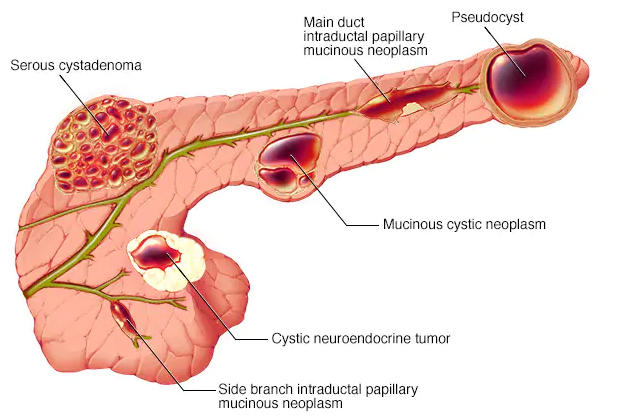
Pancreatic cysts are closed fluid-filled sacs, lined with epithelium, on or in the pancreas – a long, flat gland located behind your stomach that produces digestive enzymes, and hormones which regulate blood sugar levels. Pancreatic cysts can be divided into serous and mucinous, depending on the type of fluid they contain. There are many types of pancreatic cysts, most of which are benign (non-cancerous) but some can be cancerous. Some cysts, described as precancerous, might develop into cancer over time if left untreated.
What are pancreatic pseudocysts?
Pancreatic pseudocysts are collections of inflammatory pancreatic fluid or semisolid matter that occur within spaces inside the pancreas and are not contained inside their own enclosed sac. They usually occur as a complication of pancreatitis (inflammation of the pancreas). Pseudocysts are benign (non-cancerous).
What are the symptoms of pancreatic cysts?
Pancreatic cysts often do not cause any symptoms and may be found during imaging tests done for another reason. Symptoms of pseudocysts may occur within days to months following a pancreatitis attack.
When signs or symptoms of pancreatic cysts do occur, they may include:
● Persistent abdominal pain, which may radiate to the back
● Nausea and vomiting
● Unintended weight loss
● Abdominal bloating
● Feeling full soon after starting to eating
Fever and persistent abdominal pain may occur if a cyst becomes infected.
What causes pancreatic cysts?
The cause of most pancreatic cysts is not clear. Some types of cysts are associated with rare illnesses, including polycystic kidney disease or von Hippel-Lindau disease – a genetic disorder that can affect the pancreas and other organs.
What causes pseudocysts?
Pseudocysts often occur after an episode of pancreatitis – a painful condition in which digestive enzymes become prematurely activated while still in the pancreas causing inflammation. Pancreatic pseudocysts can also be caused by trauma.
Risk factors
Heavy alcohol use and gallstones are risk factors for pancreatitis, which can lead to the development of pseudocysts. Abdominal injury is also a risk factor for pseudocysts. The rare genetic disorder von Hippel-Lindau disease is a risk factor for pancreatic cysts.
What complications can occur with pancreatic cysts?
Rarely, pancreatic cysts or pseudocysts, may lead to complications including:
● Infection – which can sometimes lead to a pancreatic abscess
● Rupture (breaking open) or haemorrhage (bleeding) of a cyst or pseudocyst – can occur without warning and is treated as a medical emergency.
● Blockage of the common bile duct by a large cyst – causing skin, mucous membranes and whites of the eyes to appear yellow (obstructive jaundice).
How are pancreatic cysts and pseudocysts diagnosed?
Pancreatic cysts and pseudocysts can be hard to diagnose because the symptoms can be similar to various other diseases. Symptomless cysts may show up on imaging tests and scans done for other reasons.
After taking a medical history and performing a physical exam, tests may include:
● Transabdominal ultrasound
● Abdominal CT scan or MRI (magnetic resonance imaging)
● Endoscopic Ultrasound – using an ultrasound device to make images of your pancreas and connecting ducts by passing a thin, flexible tube (endoscope) into your throat and through your stomach – may be used to further evaluate a pancreatic cyst or to distinguish a pancreatic pseudocyst from other types of cystic lesions
● ERCP (endoscopic retrograde cholangiopancreatography) – uses an endoscopic ultrasound device and dye injected into the pancreatic duct and /or bile duct, to look for blockages
● Magnetic resonance cholangiopancreatography (MRCP) – uses magnetic resonance imaging to visualize the biliary and pancreatic ducts non-invasively
● A sample of the pancreatic cyst fluid may be taken using a fine needle for analysis in the laboratory.
What is the treatment for pancreatic cysts?
Treatment depends on the type of cyst or pseudocyst, its size, characteristics and whether it is causing any symptoms.
Watchful waiting: Pseudocysts and benign cysts can often be monitored without active treatment as long as they are not causing problems.
Drainage: A pseudocyst that is growing larger or causing symptoms can be drained.
This may be done using endoscopic ultrasound and a needle to drain the cyst.
Sometimes drainage through the skin, or even surgical draining, is necessary.
Pseudocysts may recur if pancreatitis is ongoing.
Surgery: May be required for enlarged, painful, cancerous or precancerous pancreatic
cysts.
Can pancreatic cysts or pseudocysts be prevented?
As most pseudocysts are caused by pancreatitis, reducing the risk of pancreatitis is the
best way to prevent pseudocysts.
Some risk factors for pancreatitis can be reduced through healthy lifestyle changes,
such as:
● Maintaining a healthy weight
● Getting regular exercise
● Avoiding smoking and alcohol
● Eating a healthy diet with less fat and more fruits and vegetables, whole grains, and lean protein